How to Draw Distillation Diagram
How to Depict Elevations from Floor Plans

This pinnacle drawing tutorial volition show you lot how to draw meridian plans required past your local planning department for your new dwelling house blueprint.
Nosotros will explicate how to draft these drawings past hand. If yous are using dwelling blueprint software, most programs have a tool to create the superlative plans from your design.
House meridian drawings are created after you have created your floor plan drawings. Run across our Make Your Own Blueprint tutorial for instructions on creating detailed flooring plans. If you are only starting out with your home pattern, check out our free Home Design Tutorial.
What are Elevation Plans and How are They Used?

Once you lot have completed drawing your detailed flooring plans, yous'll still need to create a few more than construction drawings. In improver to the floor plans, you lot will need to provide your architect and local planning department with pinnacle drawings and cross-section drawings.
The elevation plans are scaled drawings which show all four sides of the home with all perspective flattened. These plans are used to requite the architect an overview of how the finished home will look and the types of exterior finishing materials. It will too provide information about the elevation of the basis on the various faces of the domicile. For the local planning department, they will need these drawings to insure that the local building code is existence adhered to.
You will be creating four elevation views, one for each side of the firm (regardless of whether your home is of a conventional shape or non). Usually these drawings are drawn to a calibration of 1' : 1/four". Check with your builder and planning department as to what scale they prefer these drawings to be.
For each side of the house, superlative drawings should show:
- Each wall length and its height,
- The roof width and tiptop,
- The visible portion of the foundation,
- Any exterior features (such every bit decks, porches and stairs),
- Window and door trim,
- Eavestroughs,
- Exterior wall and roof finishings (e.g. wood siding on exterior walls, asphalt shingles on roof)
- The finished ground level.
Materials Required
For a list of the required drafting materials see our folio on drafting house construction drawings. Aside from a expert straight edge, an architect's scale will be very useful.
Getting Started

To typhoon your elevation plans, y'all will start with your flooring plans for the primary floor of your firm. The easiest method is to draw your elevations to the aforementioned scale as your flooring plans. To make the process a flake easier:
- Tape your primary flooring plan drawing to the surface of your work tabular array with the forepart side of the house facing towards you.
- Tape the sail of newspaper for your pinnacle cartoon but below or above the floor plan.
With this method yous will transfer each feature on the front face up of the house to the other sheet of paper.
The drawing to the correct shows a completed elevation drawing and the floor plan it was taken from. The dotted lines testify places where the walls bump in or out.
Step by Step Guide to Drawing House Elevations
Drawing Primary Floor Wall Baseline

To draw the initial baseline for the master flooring,
- Using your flooring plan drawings and starting at the farthermost left terminate of any walls on this side of the firm on the footing floor, measure the horizontal distance of this wall. Make certain you lot are including the thickness of whatsoever siding material for the exterior side walls for this level. This siding tin be very thin in the example of parging or thick in the case of stone or brick.
- Draw a faint line the same length of this wall towards the bottom left third of your page. This faint horizontal line volition later be erased since it will not be visible from the outside of the house (unless the outside finish of the house changes at this verbal bespeak). It is drawn at present only as a reference from which to measure to the top of the next floor or roof line.
- Brand a small upward tick mark at the end of this wall.
- If there is some other exterior wall at the same tiptop to the right of this wall (for example a wall that bumps out or recedes in from this first wall), measure this wall in the same fashion as the first.
- Draw this next line as a continuation of the commencement line. Exercise non erase the tick mark that indicates the segmentation between these walls.
- Continue on marking walls in this way until yous accomplish the end of walls on this side of the business firm.
Determining and Drawing Wall Heights

Next you will draw the vertical lines for the exterior walls on this side. For each of the wall bases:
- Determine how high the wall will be above its unfinished floor tiptop. To do this y'all will demand to consider the height of the ceiling of the rooms within this section of the house and add to that the height of any floor or ceiling joists higher up information technology. Also add together on the elevation of whatsoever sub-flooring, if there are floors in a higher place.
- Draw faint vertical lines up from each of the wall base lines to the elevation yous have determined in the previous step. (Subsequently you will draw a darker line which includes the finished material on the outside of the home.)
- Draw a faint horizontal line at the level of the upper ceiling joists or subfloor higher up this level.
- If there is another floor above this level, continue on to the step 5. Otherwise move on to the next section, Draw Window and Door Outlines.
- Using the floor plans for the next level up, perform steps 1 through 3 again making tick marks where you will demand to draw whatsoever vertical walls. Once over again determine the heights of these walls then draw a faint horizontal line to show the level of the top of the sub-flooring or ceiling joists for the adjacent level.
- Continue repeating the higher up steps until you have no floors above the current level. So move on to the next section, Draw Window and Door Outlines.
Describe Window and Door Outlines

For all of your windows and doors, mensurate from the horizontal lines of your floors to position the exterior doors and windows. Your construction drawings, ordinarily the cross-sections, will detail the top at which each window should exist placed. A separate window and door schedule gives the dimensions for all your windows and doors.
At this betoken, using your builder'southward scale for accuracy, draw just the outline of the window and door outside dimensions to the aforementioned calibration as your walls, floors and roof. Later you will draw the exterior window and door trim.
Cartoon the Roofs
The roof lines tin can be of many styles: gable, shed, hip, gambrel, etc.
To draw the roof for each elevation view, offset consider whether your roof will overhang and drop below the outside wall on the elevation programme you lot are currently drafting. For a shed or gable roof with eaves, the roof on ii sides will drib lower than where it connects with the wall. From the view of the other ii sides it volition stay at one level. Accept a expect at the elevations at the very meridian of this page to see an illustration of this.
Dropping Roofs

If this level has an overhanging roof that slopes down over the wall, you lot will demand to practise some calculations for roof overhang before you draw the horizontal line for the wall elevation.
If at that place is a roof overhang at this level which drops downward over the wall, calculate how much the roof will drop in the actual overhang area. To exercise this,
- Have the gradient or pitch of your roof, which is commonly described as the rise over run in the form of five:12, half-dozen:12, xiv:12, etc. The starting time number refers to how many inches (or centimetres) the roof will ascent (or drop) over a horizontal altitude indicated by the 2nd number (which in North America is normally 12 inches).
- Accept your horizontal roof overhang to determine what the vertical roof overhand drop volition be. For instance if you have a 5:12 roof pitch and a 12 inch horizontal roof overhang, the roof will drop a full of 5 inches. If your horizontal roof overhang was xviii inches, the roof would drop eighteen/12 10 v = 1.five ten 5 inches = seven.5 inches.
- At present you will need to subtract this drib from the height of the wall that you previously calculated since in the elevation drawing this roof line will drop below the top of the wall height. Using this new calculated height, describe the line showing the lower border of the roof line.
Non-Dropping Roof Lines
For an end gable wall or a shed wall, make up one's mind the highest betoken of the wall below your roof. To practise this you need to know the gradient of the roof. First read the section above on roof pitch, then calculate the height of summit most bespeak of your roof above the electric current floor in the post-obit way.
- Measure the horizontal distance from one of the side walls of the firm in this acme view to where the peak of the roof will exist. For some houses this will be the middle of the house, for other roof styles information technology may not be the center. We'll telephone call this Altitude to Top.
- Then summate Distance to Elevation ten Roof gradient where roof gradient is the rise/run. For example for a 5:12 roof slope and a distance of 13 feet the peak for the elevation of the roof (above the current flooring) would exist: 12 feet 10 5 / 12 = 5 feet.
- Mark a tick on the flooring surface to bespeak the spot higher up which will prevarication the roof pinnacle. Extend a faint vertical line up from this betoken.
- Measure up this line to the height you have just calculated in a higher place.
- Now join this roof peak to the exterior edge of the house.
- If the roof slopes directly downwards to the other side of the house you tin can draw another line from the roof meridian to the other edge of the business firm as well.
Next make up one's mind the thickness of your actual roof including all framing and the roof itself and depict this onto your peak cartoon.
Brand sure that you have included all roofs that are visible from this house face. Notice in the meridian in a higher place, the pocket-size portion of shed roof which covers a bumpout on the right side is visible.
Basements, Foundations and Chimneys

Next add on the basement, crawl space or foundation. For the elevation views y'all need just show the parts of this level which are visible above ground. Other drawings, called cross-sections, will provide further building details for this part of the home.
For the lower level or foundation, beginning determine if the lower wall, without any finished surface such as siding or stucco, will protrude from the upper wall. Then consider what blazon of finishing volition be on the foundation and what will be on the upper levels. For some homes the concrete foundation may take parging or stucco and the upper level(s) may accept a unlike finishing. If the whole house will have the same finish blazon hopefully your home pattern is such that the lower foundation wall is flush to the upper wall(s). If not, at present is the fourth dimension to adjust your foundation plans and then that they will be flush.
If the sidings will alter, consider whether y'all want them flush, the finished foundation wall protruding, or inset. There is no correct way to exercise information technology but in general an inset foundation wall could give your home a somewhat unstable look. If yous are edifice a traditional wood framed habitation you lot have a bit of latitude as to where on the thick foundation wall you volition set the wood framing for the floor in a higher place. In this way you can determine exactly how your upper finished walls volition or will not line up.
Once you accept adamant where the foundation wall will sit, draw a faint line from the main floor down to slightly beneath what y'all think volition be your finished ground height.
Now yous can likewise add any chimneys. Equally with the walls you take drawn, brand sure that you include the thickness of any finishing materials that may exist on the chimney, be it wood siding, brick or stone.
Detail Exterior Finishing
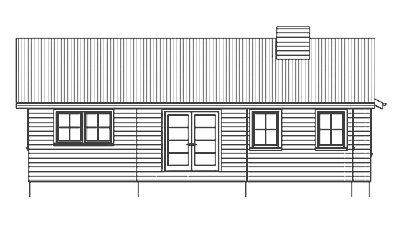
- If yous will have woods or another type of siding (horizontal, vertical or cedar shake) draw these lines to indicate the cease. For a stucco wall yous need not draw any surface. For a brick or rock wall, the finish should be fatigued. Make certain you include whatever trim bands, belt lines, etc.
- Using your architect's calibration, draft in all window and door trim as well as particular whatsoever window or door lites, and outside knobs or handles.
Decks, Porches and Railings and Finished Ground Level
- Now depict in any decks or porches, their railings and stairways. This tin exist fiddly work, especially drawing the railings. Use your scale to brand sure your cartoon is accurate.
- Then add on any other architectural features such equally fascia, gutters or downspouts.
- Next do an accurate measurement of what you program to have as the difference of your main floor height to the final level of the landscaping around the house. This may exist fairly flat around the whole firm or it may leave a portion of the basement or foundation completely above footing with another office almost completely buried.
- Draw this finished landscaping line along the walls of this pinnacle view.
- Finally, clearly label the cartoon to indicate verbal finishing materials to be used on exterior surfaces, this includes roofing materials and siding.
Repeat this procedure for the other iii sides of the abode.
As with the floor program drawings, it is necessary to include a title block on the page which specifies the house name, the appointment, and the calibration used. The title cake is by and large in one corner of the drawing.
Next House Construction Cartoon Tutorial
Check out the adjacent blueprint tutorial module: Drawing Cross Sections.
No office of this web site may be reproduced or copied without written permission. Illegal Net copies will be detected by Copyscape.

How to Draw Distillation Diagram
Source: https://the-house-plans-guide.com/elevation-drawings.html
0 Response to "How to Draw Distillation Diagram"
Post a Comment